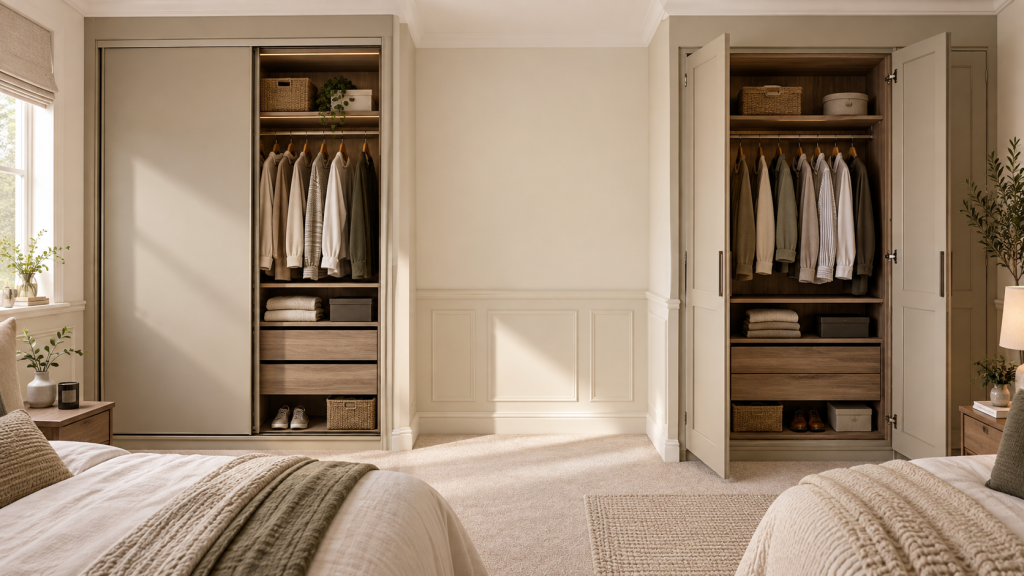
Sliding wardrobes are generally better for small bedrooms because their doors run along a trackinstead of swinging outward, saving up to a metre of floor clearance. Hinged wardrobes usually offer easier full access to the interior and tend to cost less, making them better suited to larger rooms where door clearance isn’t a constraint.
How Sliding Wardrobes Work
A sliding wardrobe has one or more large door panels that run along a top and bottom track, moving side to side rather than swinging open. Because the door never leaves the plane of the wardrobe front, you don’t need to allow for a door swing arc in front of it — only the width of the room the wardrobe already occupies.
How Hinged Wardrobes Work
A hinged wardrobe uses traditional swing doors attached with hinges, similar to a kitchen cupboard scaled up. Opening the door requires clearance in front of the wardrobe equal to roughly the door’s width, and most hinged wardrobes let you open both doors fully to see the entire interior at once.
Sliding vs Hinged Wardrobes: Full Comparison
| Feature |
Sliding Wardrobe |
Hinged Wardrobe |
| Floor clearance needed |
Minimal — no swing arc |
Door-width clearance required in front |
| Full interior visibility |
Partial — one section covered at a time |
Full — both doors open wide |
| Best for |
Small bedrooms, beds close to the wardrobe |
Larger bedrooms, walk-in style spaces |
| Typical price point |
Higher |
Lower to mid |
| Internal storage capacity |
Similar or slightly more (full wall width |
Similar, depends on unit size |
| Mechanism maintenance |
Track and rollers need occasional care |
Hinges occasionally need tightening |
| Visual footprint |
Sleeker, often mirrored or flush-front |
More traditional look |
Which Wardrobe Suits a Small Bedroom Best?
In a small bedroom, floor space is the scarcest resource, and that’s exactly what sliding wardrobes are designed to protect. If your bed sits close to the wardrobe, or there’s a walkway directly in front of it, a hinged door simply may not open fully without hitting the bed frame — a sliding door sidesteps that problem entirely. As a working guide:
- Under roughly 3m² of usable bedroom floor space: sliding wardrobe is almost always the better fit
- 3–4.5m²: either can work, but check the exact door swing clearance against your furniture layout
- Over 4.5m²: hinged wardrobes become a realistic option without compromising walkways
Do Sliding Wardrobes Give You Less Storage?
Not necessarily. Many sliding wardrobes are built wider (spanning a full wall) precisely because they don’t need door-swing clearance, which can offset or even exceed the storage volume of a narrower hinged unit. The real difference is access style, not total capacity, in most cases.
Are Hinged Wardrobes Easier to Organise?
Generally yes — because both doors open fully, you can see and reach the entire interior at once, which makes it easier to organise hanging rails, shelves and drawers without anything being blocked by a closed door panel.
Cost and Durability: Sliding vs Hinged
Hinged wardrobes are usually the more affordable option, since the hardware (hinges) is simpler and cheaper than a sliding track-and-roller system. Sliding wardrobes cost more upfront but the mechanism, when well made, is built for frequent daily use — the main maintenance point is keeping the track clean and the rollers aligned, which prevents the door from sticking or derailing over time.
Practical Tips for Choosing Between Them
- Measure the exact clearance in front of where the wardrobe will sit before assuming a hinged door will open fully
- If the wardrobe faces a bed, check the door swing doesn’t collide with the mattress edge
- For rented properties or rooms you may reconfigure later, hinged wardrobes are typically easier to disassemble and move
- Mirrored sliding doors can make a small bedroom feel larger, which is worth factoring in alongside the practical measurements
Frequently Asked Questions
Q: Are sliding wardrobes better than hinged wardrobes for small rooms?
A: Yes, in most small bedrooms sliding wardrobes are the better choice because they don’t need floor clearance for a door to swing open, which matters most when the bed or other furniture sits close by.
Q: Do sliding wardrobe doors break more easily than hinged doors?
A: Not when properly maintained. Sliding mechanisms rely on tracks and rollers rather than hinges, so occasional cleaning and alignment checks keep them running smoothly; problems usually stem from dirt in the track rather than the mechanism itself wearing out.
Q: Can I fit a sliding wardrobe in a room with a sloped ceiling?
A: Yes — sliding wardrobes are often a good fit for loft or attic bedrooms since the door doesn’t need vertical swing clearance, only horizontal track space.
Q: Which is cheaper, a sliding or hinged wardrobe?
A: Hinged wardrobes are typically less expensive, since the hinge hardware is simpler than a sliding track-and-roller system. Sliding wardrobes cost more but can be worth it in space-constrained rooms.
Q: How much clearance does a hinged wardrobe door need?
A: Allow roughly the width of one door panel as clearance in front of the wardrobe so it can open fully without hitting a bed, wall, or other furniture.