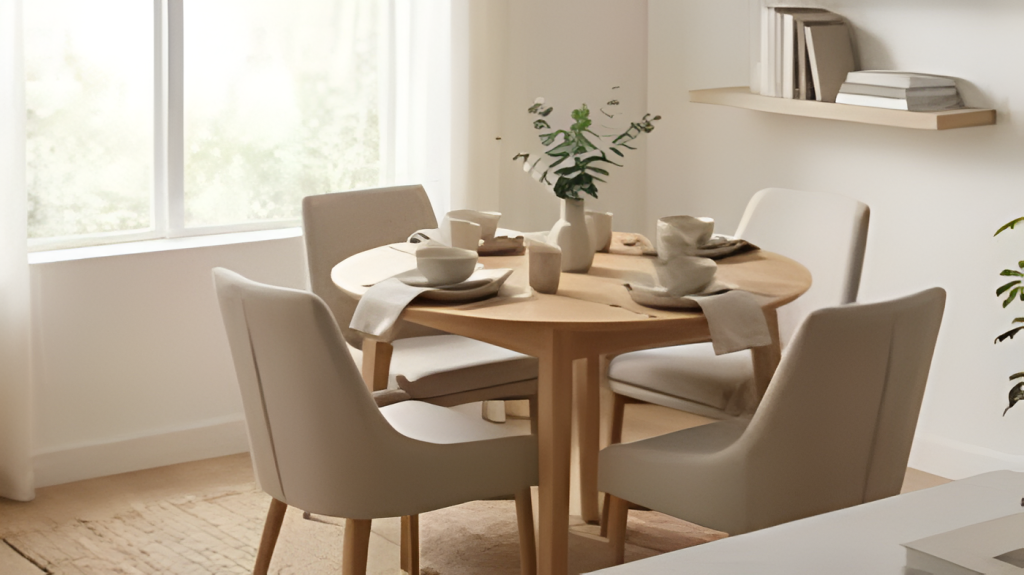
An extendable dining table works as a compact table for everyday use and extends — via a pull-out leaf, drop-leaf side, or separate insert leaf — to seat more guests when needed. For small UK homes, a table that seats 2–4 closed and extends to seat 6–8 gives you daily space savings without sacrificing capacity for family visits or dinner parties.
How Extendable Dining Tables Work
There are three common mechanisms:
- Pull-out / pop-up leaf: a hidden leaf stored under the tabletop slides out and locks flush, extending length without needing a separate leaf to store.
- Drop-leaf: one or both sides hinge downward when not in use, folding up (sometimes supported by a swing leg) to extend the table.
- Separate insert leaf: an additional leaf panel is stored separately and slotted into the table when extending — offers the biggest size increase but requires storage space for the leaf itself.
What Size Extendable Table Do You Need?
| Seats(closed) |
Closed size (approx.) |
Extended size (approx.) |
Best for |
| 2–4 |
70–110cm x 70–90cm |
150–180cm x 90cm |
Studio flats, small kitchens |
| 4–6 |
110–140cm x 80–90cm |
180–220cm x 90–100cm |
Most small-to-medium UK dining rooms |
| 6–8 |
140–180cm x 90–100cm |
220–260cm x 100–110cm |
Larger households, regular entertaining |
These figures vary by manufacturer, so always check the exact dimensions listed on the product page rather than relying on the seat count alone.
How Much Space Does an Extendable Table Actually Save?
Compared with a fixed 6-seater table, a 4-seater extendable table that opens out to 6–8 seats can free up 1 to 1.5m² of floor space on a normal day — enough to fit an extra chair or a sideboard, or simply make the room feel less cramped — while still handling occasional larger gatherings without buying a second table.
Drop-Leaf vs Pull-Out Leaf: Which Should You Choose?
- Drop-leaf: best when floor space is very tight, since the table shrinks down to a narrow, console-like shape against a wall when not extended
- Pull-out leaf: best for daily ease, since there’s no separate leaf to store or lift — the extension is built in
- Separate insert leaf: best when you want the largest possible size jump, but only if you have somewhere flat and dry to store the spare leaf
Can One Person Extend a Dining Table Alone?
Most pull-out and drop-leaf mechanisms are designed for one person to operate without help, since they’re built into the frame. Separate insert-leaf tables are usually a two-person job, particularly on larger tables, since the tabletop needs to be lifted apart to fit the leaf.
Do Extendable Tables Wobble More Than Fixed Tables?
A well-built extendable table shouldn’t wobble more than a fixed table — the key is checking for a solid locking mechanism on the extension and a sturdy leg and frame structure, rather than assuming all extendable mechanisms are equal.
Matching Your Extendable Table to Your Dining Chairs
Leave at least 60cm of width per seated guest when the table is extended, and check seat height against the table’s clearance (typically a 28–30cm gap between seat and tabletop is comfortable). If chairs will be pushed in against a wall when the table is closed, measure that stored footprint too, not just the open dining layout.
Frequently Asked Questions
Q: What size extendable dining table do I need for a small room?
A: As a general guide, a table that seats 2–4 when closed (around 70–110cm closed length) and extends to seat 6–8 gives small UK dining rooms flexibility without permanently taking up large floor space.
Q: Can an extendable dining table be used every day in its extended size?
A: Yes, most extendable tables are built to stay extended long-term if needed — the mechanism is there for flexibility, not just occasional use, though it’s worth checking the specific table’s build quality if you plan to leave it extended most of the time.
Q: What’s the difference between a drop-leaf and a pull-out extendable table?
A: A drop-leaf table has hinged sides that fold down when not needed, shrinking its footprint significantly. A pull-out table has a hidden leaf that slides out from inside the frame, which is usually quicker to operate but doesn’t shrink the table’s width as much when closed.
Q: How much floor space should I leave around an extended dining table?
A: Leave roughly 90cm to 1m of clearance around the table on all sides where people need to pull out chairs and walk past, more if it’s a frequently used walkway.
Q: Do extendable dining tables come with matching chairs?
A: Not always — some are sold table-only, others as part of a set. Check the specific listing, and make sure any chairs you pair separately suit the table’s height and seat spacing.