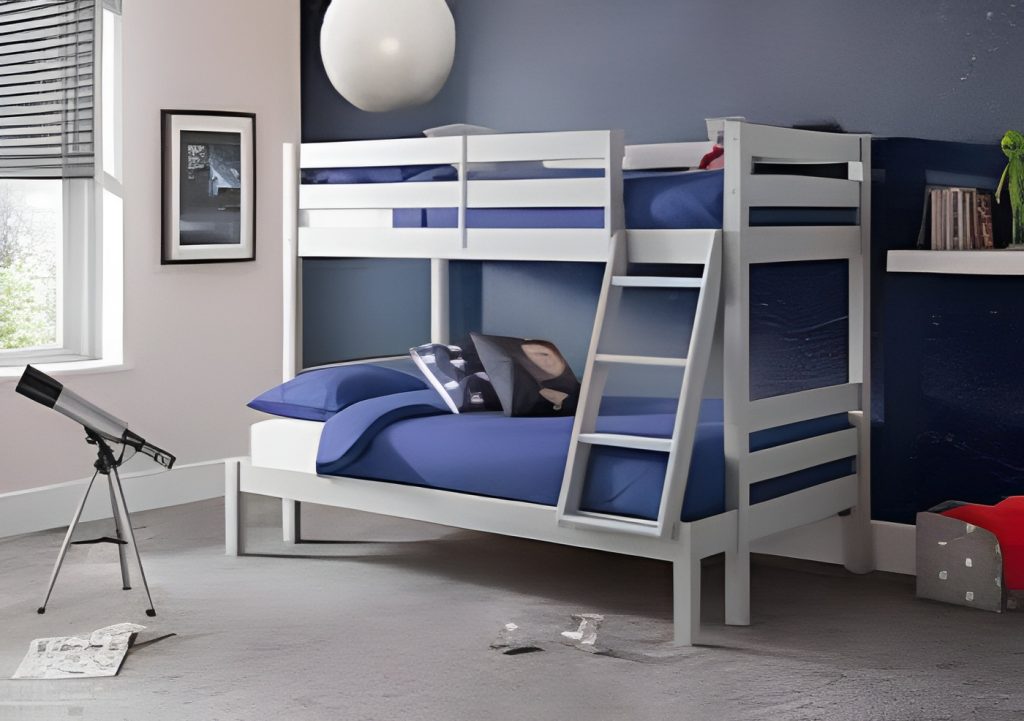
A bunk bed stacks two full-size beds vertically to sleep two children in one footprint, while a cabin bed raises a single bed to create storage, a desk or play space underneath. Bunk beds suit shared bedrooms needing two sleeping spaces; cabin beds suit a single child’s room where storage or workspace matters more than a second bed.
What Is a Bunk Bed?
A bunk bed stacks two full-size single beds, one above the other, within the same floor footprint as a single bed. The top bunk is reached by a ladder and fitted with a secure guard rail along any open side, while the bottom bunk functions as a normal single bed.
What Is a Cabin Bed?
A cabin bed raises a single bed on a frame, using the space underneath for storage drawers, a desk, a small wardrobe, or an open play area. Unlike a bunk bed, it only sleeps one child — the extra height is used for function rather than a second bed.
Bunk Bed vs Cabin Bed: Full Comparison
| Feature |
Bunk Bed |
Cabin Bed |
| Sleeps |
Two children |
One child (plus the space below) |
| Underneath space used for |
Second bed |
Storage, desk, wardrobe, or play area |
| Minimum recommended age (top bunk) |
Around 6 years (BS EN 747 guidance) |
No separate upper-bed age restriction |
| Floor footprint |
Same as one single bed |
Same as one single bed |
| Best for |
Siblings sharing a room |
A single child’s room needing more function |
| Ceiling height needed |
Higher (bunk plus mattress clearance) |
Standard |
How Much Space Do You Save With a Bunk Bed?
Because a bunk bed occupies the same floor footprint as a single bed while sleeping two children, converting a shared room from two separate singles to one bunk bed set-up typically frees up 2–3m² of usable floor space — enough to fit in a wardrobe, a desk, and still leave room to walk.
When a Cabin Bed Makes More Sense Than a Bunk Bed
- Only one child needs a bed in the room
- Built-in storage or a desk matters more than a second sleeping space
- Low ceiling height makes a bunk bed impractical
- You want a design that can be reconfigured later as your child grows, without replacing the bed itself
Are Bunk Beds Safe for Young Children?
Bunk beds are safe when used within the manufacturer’s age guidance — in the UK, the relevant safety standard (BS EN 747) generally recommends children on the top bunk are at least 6 years old, with secure guard rails fitted on all open sides. Younger children are better suited to the bottom bunk only, or a cabin bed instead.
Can a Cabin Bed Be Converted Later?
Yes — many cabin beds are modular, so the desk, wardrobe or drawer units underneath can be removed or swapped as a child’s needs change, without needing to replace the bed frame itself.
Bunk Bed vs Cabin Bed: Which Should You Buy?
Choose a bunk bed when two children are sharing a room and floor space is tight. Choose a cabin bed when one child needs a single bed but the room also needs to double as a play area, study space or storage. Furniture Bazaar’s bunk and pine bed ranges cover both single and shared bedroom setups, so the decision usually comes down to how many children are sleeping in the room rather than budget alone.
Frequently Asked Questions
Q: What age is recommended for the top bunk of a bunk bed?
A: UK safety guidance (BS EN 747) generally recommends children sleeping on the top bunk are at least 6 years old, with secure guard rails fitted. Always check the specific manufacturer’s age guidance before buying.
Q: Is a cabin bed suitable for an adult?
A: Most cabin beds are sized for children and built on single-bed frames, so they’re not generally designed for adult-length use — check the specific dimensions if this applies to you.
Q: How much ceiling height do I need for a bunk bed?
A: Allow enough clearance for a child to sit upright comfortably on the top bunk — as a general guide, a ceiling height of at least 2.3m is recommended, though this varies by bed design.
Q: Can you put a bunk bed in a room with a low ceiling?
A: It depends on the specific ceiling height and bed design — if clearance is tight, a cabin bed (which only raises the bed partially) is often the safer, more comfortable option.
Q: Do cabin beds come with storage included?
A: Many do, but not all — check the specific product listing, as cabin beds range from a simple raised frame to models with built-in drawers, a desk or a wardrobe underneath.